
[ad_1]
The Android experience Google’s phones provide has come a long way from the early days of Nexus phones. They bring a lot to the table, so much that I can’t go back to a non-Pixel phone now, despite the fierce competition. Read on to learn why.
1 I Enjoy Using Stock Android

It might surprise you, but I wasn’t always an Android fan. As an early teenager, there was no shortage of Android phones around me, and I always found the experience laggy and bloated. For context, I wasn’t into iOS either and used Windows Phone for as long as possible.
When I did switch to Android, it was with Motorola phones that were released under the Android One program, providing a near-stock Android experience. The experience was great, but nothing matched Pixels at the time.
To be clear, the Android you get on a Pixel isn’t fully “stock” either. Pure stock Android lacks many features and is more of a starting point for device manufacturers to build on. So, something like Samsung’s well-polished OneUI will be better than stock Android.
Google’s implementation of Android has added features here and there to enhance the user experience without unnecessary bloatware, creating an experience that even the least tech-savvy users can enjoy without getting lost in settings and launchers that end up making the whole Android experience more complicated than it needs to be.
2 Pixels Get Timely Software Updates for Years

Google’s Android experience won’t mean much without timely software updates, and who better to provide timely Android updates than the creator of Android itself? If you’re using a Pixel, you’re the first in line for any feature and security updates that arrive on Android.
Since other manufacturers need to work on updates from Google to ensure they work best with their custom launchers and overall Android implementation, updates on every other Android phone are delayed.
While feature updates are not as frequent as Android security updates, I’ve received Pixel Feature Drops much more frequently than what competitors like Samsung, Motorola, OnePlus, and others provide.
You’ll also be the first to get Android version updates, whether you’re a beta tester or want the polished, full-release version. Pixel phones are also future-proof, considering you can get Android version and security updates for as long as seven years.
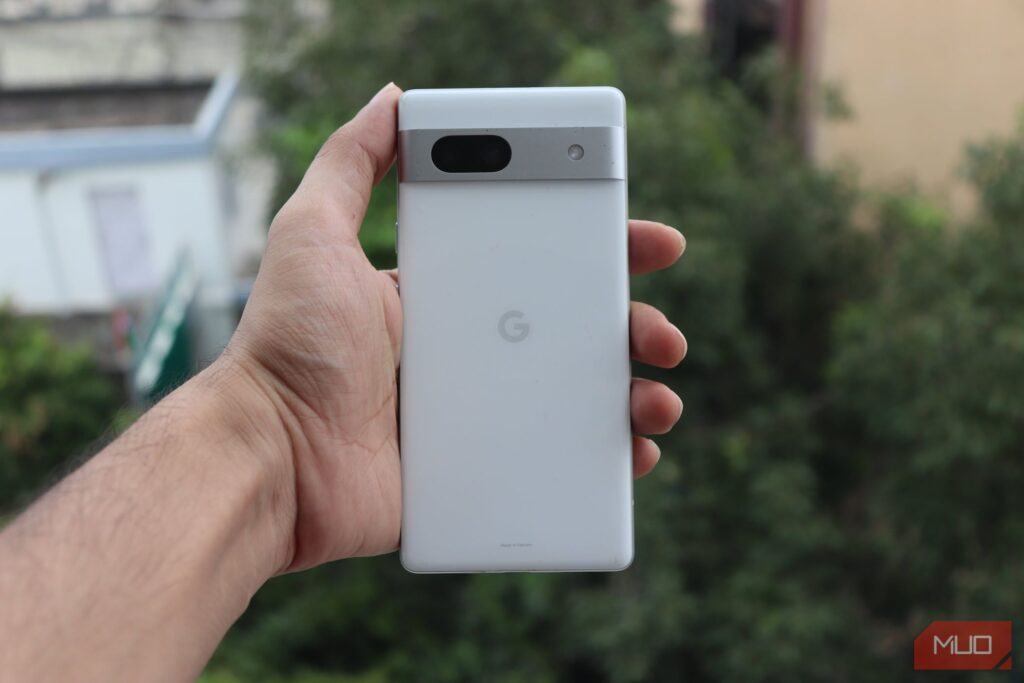
While manufacturers like Samsung also offer seven years of security and feature updates, this only includes its flagship phones from 2024. For comparison, my mid-range Pixel 7a (launched in May 2023) will get security updates until 2028 despite being nearly two generations older than the current Pixel lineup.
3 Unbeatable Camera Quality

The one thing Pixel phones have been known for ever since the first Pixel came out in 2016 is the camera quality. For years, while the competition focussed on cramming as many megapixels into their cameras as possible, Google made the most of the same old 12MP sensor across the first five generations of Pixel phones. And when it did change the sensor, the upgrade meant even better photos.
As someone who carried around a DSLR and two lenses every day for three years before getting a Pixel, I can safely say that it’s the only phone I’ve used that gives me enough confidence to snap a quick photo and know it’ll turn out great.
Most photos you take with your Pixel phone will be evenly lit, sharp, and overall quite detailed. These photos also have a distinct “Pixel” look with the saturation turned up just a notch. Check out the photo of the night sky I took with my Pixel 4a, for example.

The AI features baked into Google’s stock camera app also aren’t to be taken lightly. Night Mode still produces some of the best low-light pictures you’ll see on any Android device. Magic Eraser makes taking pictures in public so much easier, and Best Take makes group photos a breeze in case you don’t have a helping hand. That’s just the tip of the iceberg.
That’s not to say other phones haven’t caught up to Google’s computational photography wizardry. You’ll find some pretty sweet cameras on most, if not all, Android flagships, but Pixels are the only devices where the camera experience is consistent regardless of whether you have the latest phone or not.
4 Snappy Day-to-Day Performance

I’ll admit that Pixels aren’t the best value for money when it comes to hardware specs. Google’s Tensor lineup of mobile processors failed to be the Qualcomm Snapdragon or Apple Bionic rival that the software giant was hoping it would be. However, as far as daily performance is concerned, I don’t think you’d complain.
Specs and benchmark scores are one thing, but real-world usage is another. There’s a reason why your phone might start to feel slower as years go by, but you won’t be facing that issue on a Pixel.
My Pixel 7a, powered by the Tensor G2 chip, runs perfectly fine with no lags or performance issues of any sort. Even my Pixel 4a from 2020 is still perfectly usable as a daily driver, but since it packs an older Qualcomm Snapdragon 730G chip, it’s not quite an apples-to-apples comparison.
The good performance is largely attributed to Google’s software wizardry with Android and all the neat little features it packs into Pixel phones. However, performance shouldn’t be an issue with the Pixel 9 series since Google is confident enough to provide seven years of software updates.
However, the Tensor chips are still behind the competition. If you push a Pixel to its limits, for example, with a graphically demanding game, the phone might still drop a frame or two and can overheat. There have been reports of the battery life being inconsistent on Pixels, but I haven’t experienced this, nor has anyone I’ve recommended a Pixel to.
Overall, unless you plan on playing games or shooting 4K videos under the sun frequently, you shouldn’t face any problems with regular, day-to-day usage and multitasking.
5 Google’s Ecosystem Is as Good as Android Gets

One great thing about Android is that it allows users to choose devices from different ecosystems and have them work together. However, manufacturers have developed their own ecosystems over the years. You can even use Android without any Google apps at all.
However, that’s not something most people do. For the average user, the convenience Google’s ecosystem brings is much more precious than niche features they might never use. Unless you have a specific preference or requirement, I don’t think you’d want alternatives or third-party options.
There are many Pixel-exclusive AI features sprinkled throughout the UI, like Circle to Search, which lets you select anything on your screen and look it up on Google without launching your browser, and Now Playing, which automatically detects ambient music playing around you.
Google has very neatly integrated these features into the Pixel user experience. Once you start using them as you go about your day-to-day business, you’ll wonder how you lived without them. I know I do.
A combination of these features, camera quality, long-term software support, and the overall user experience has helped me appreciate my Pixel phone to the point that I can’t switch to a Samsung, OnePlus, or Motorola phone, at least as long as Android and iOS remain the only two options.
[ad_2]
Source link